Serie A Fans in Italy Reach 25.6 Million: Juventus Still No. 1, Ahead of Inter and Milan

Growth is stronger among mid-sized and smaller clubs, with Cagliari and Parma standing out
The Sponsor Value research, conducted by StageUp in partnership with Ipsos Doxa, once again provides an annual snapshot of football fandom in Italy, a pillar of Italian identity involving 68.5% of the Italian population and 87.2% of those interested in Serie A.
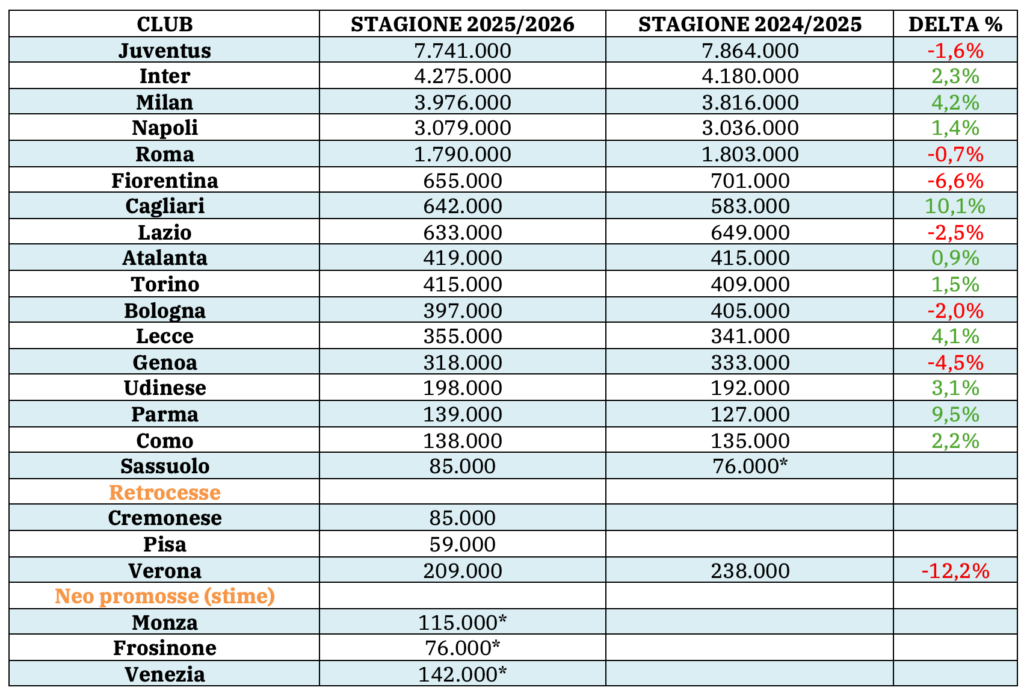
Fans of Serie A football clubs in the 2025/26 season numbered 25.6 million in Italy, a figure that remained essentially stable compared with the 2024/25 season, increasing by 0.32%.
The figure comes from the Sponsor Value survey conducted by StageUp in partnership with Ipsos Doxa, now in its 26th year. The findings confirm that interest in Serie A translates into a strong sense of symbolic belonging, a cultural characteristic that makes club football fandom a genuine pillar of Italian identity.
The phenomenon continues to be driven primarily by the emotional connection passed down through families and local communities rather than by sporting or managerial success. However, the latter is becoming increasingly important in a sporting world that is ever more globalised, virtual, fast-moving and dominated by increasingly fluid forms of fandom.
WHO ARE THE FANS?
The football fan base continues to be remarkably diverse. Men account for 55% and women for 45%, confirming that passion for football is becoming increasingly balanced and inclusive, gradually breaking down traditional gender boundaries.
The average age is relatively mature, with the 35–54 age group accounting for 47% of fans. At the same time, under-24s represent a solid 16% of the total.
Geographically, the distribution broadly reflects the Italian population. Southern Italy and the Islands lead with 39% of fans, followed by the North-West with 26%.
In southern regions, supporting a favourite club remains a powerful expression of identity, belonging and social aspiration.
From an economic perspective, football fandom is predominantly a middle-class phenomenon: 59% of supporters belong to the middle-income segment, confirming that football remains one of the few major social forces capable of bringing together people from different income groups and backgrounds under the same colours.
TOP 5: JUVENTUS STILL FIRST, INTER LEADS IN MILAN
The Top 5 most supported teams remains unchanged.
Juventus retains first place with 7,741,000 fans, despite a declining trend for the second consecutive year, down 1.6% compared with 2024/25. The decline can be attributed both to sporting results and to a club identity that has become increasingly disconnected from the expectations of its supporters.
In second place is Inter, the Italian champions, with 4,275,000 fans, up 2.3% compared with 2025.
Two league titles in the last three seasons, the 2026 Coppa Italia triumph, and strong performances in European competitions have enabled the Nerazzurri to remain ahead of their city rivals for the fourth consecutive year.
Milan follows in third place with 3,976,000 fans, recording a stronger 4.2% increase in a season that saw improved performances on the pitch, despite missing out on Champions League qualification on the final matchday.
Completing the Top 5 is Napoli, with 3,079,000 fans, up for the second consecutive year (+1.4%), followed by Roma, with 1,790,000.
Fiorentina ranks sixth with 655,000 supporters, down 6.6% after a difficult season that fell short of initial expectations. It was one of the most challenging campaigns in the club’s recent history and was also marked by protests from supporters.
MID-SIZED CLUBS RECORD THE STRONGEST GROWTH
The research once again highlights a trend in which the largest percentage increases in fan bases are being recorded by mid-sized and smaller clubs.
Cagliari, with 642,000 fans, overtakes Lazio and records the strongest growth of any club, increasing by 10.1% compared with 2024/25.
Above the overall average, growth was also recorded by Parma, now at 139,000 fans (+9.5%), Lecce with 355,000 (+4.1%), Udinese with 198,000 (+3.1%), and Como with 138,000 (+2.2%).
What is driving this growth?
First of all, there is the statistical phenomenon known as the “base effect”, according to which percentage increases are easier to achieve when starting from a smaller absolute fan base.
Beyond this, however, the figures reveal three broader sociological drivers that go beyond individual cases.
Cagliari is benefiting from the powerful David-versus-Goliath narrative: by defeating a more prestigious opponent, the team creates a story of redemption that extends beyond its traditional geographical boundaries and attracts support from fans elsewhere.
Como is also capitalising on results that have exceeded expectations, but at the same time on a broader model focused on social engagement, aesthetics and global ambitions.
Parma, Lecce and Udinese demonstrate how sporting and managerial planning can represent the most universal and sustainable driver of growth. Consistency in objectives and actions over time can transform initial sympathy into a lasting sense of identity and belonging.
STATEMENT
“The size of a club’s fan base is not merely a matter of image; it translates directly into an increase in the value of individual clubs,” comments StageUp President Giovanni Palazzi.
“A larger number of supporters means greater bargaining power in negotiations with sponsors, greater appeal to potential investors in the sports company, and an increase in revenues generated by merchandising, season tickets and digital content.
“As also highlighted by our Football Sponsor 360 service (www.footballsponsor360.com), which is designed to assess, negotiate and plan sponsorships in Serie A, the Italian market could generate more than €60 million in additional revenues through better exploitation of the relationship between club brands and sponsors.
“That would represent a 10% increase in sponsorship revenues for the top division, a significant amount for the sustainability of the football system — and, unfortunately, one that Serie A is currently leaving on the table.”